
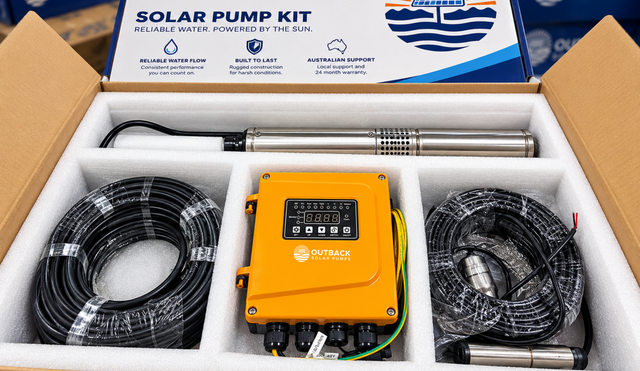


If your bore pump is too small, tanks run short and stock water becomes a daily headache. Too big, and you can end up paying for panel capacity and pump performance you do not actually need. That is why getting the size solar pump for bore use right from the start matters - not just for performance, but for reliability, cost and long-term running ease.
For most rural properties, bore pump sizing is not about finding the biggest unit that fits the budget. It is about matching the pump, controller and solar array to the real job. That means how much water you need each day, how far the water has to travel, what the bore can sustainably produce, and how the system will operate across changing sun conditions.
What actually determines size solar pump for bore jobs
When people ask what size solar pump they need, they are usually talking about flow rate. Flow matters, but it is only one part of the job. A solar bore system is sized around four main figures: daily water requirement, total dynamic head, bore yield, and available solar input.
Daily water requirement is the first one to lock in. If you need 20,000 litres per day for troughs, tank refill or transfer, that target drives the rest of the system. It is far easier to size a pump once you know the water task in litres per day rather than guessing from pump horsepower alone.
Total dynamic head is the second major factor. This is the full vertical and friction load the pump has to overcome. It includes the pumping water level in the bore, the height to the tank or outlet, and pipe friction losses through the delivery line. A pump pushing water 40 metres up from a shallow standing level is a very different job from one lifting out of a deep bore and then running another few hundred metres to a hilltop tank.
Bore yield matters because the pump can only move what the bore can provide. If the bore recovers slowly, fitting a larger pump will not create more water. It can actually make the system less stable if the pump outruns recharge and trips on low water.
Then there is solar input. A solar pump does not behave exactly like a fixed-speed mains pump. Output can vary through the day with irradiance, panel orientation, temperature and weather. A well-sized solar pump system is balanced so it produces enough water across realistic daylight hours, not just under perfect midday sun.
Start with litres per day, not pump power
The cleanest way to size a solar bore pump is to begin with daily demand. Ask how much water the site uses on a typical day, and what peak demand looks like in hotter months. Stock numbers, trough turnover, household use, garden irrigation and storage refill all need to be factored in honestly.
If the pump is filling a storage tank, you have useful flexibility. The system can pump steadily through the day and the tank handles overnight and peak draw. This is often the best fit for solar because it works with daylight rather than fighting it. If you need direct pressure on demand, that becomes a different design question.
It also pays to leave some margin. Not a wild oversize, just enough breathing room for cloudy spells, seasonal demand changes and panel ageing over time. A system built with no margin can look fine on paper and still leave you short when conditions are ordinary rather than ideal.
A quick example
Say a property needs 15,000 litres a day into a header tank. If the site gets around 6 effective pumping hours across most of the year, the pump needs to average roughly 2,500 litres per hour over that window. That is only the starting point. Once head and bore conditions are added, the pump model may change completely.
Measure total head properly or the pump choice will be wrong
This is where many sizing mistakes happen. People use bore depth instead of pumping level, or they ignore delivery friction and wonder why the flow is poor once everything is installed.
For bore work, the number that matters is not simply the drilled depth. It is the dynamic water level while pumping, plus the delivery height above ground, plus friction losses in the pipe. If the water level sits at 35 metres static but drops to 50 metres while pumping, size from the pumping figure, not the static one.
Friction loss can be modest or significant depending on pipe diameter, line length and flow rate. Long transfer lines, undersized poly and multiple bends all add resistance. On some setups, friction is only a few metres of head. On others, it is enough to push the system into a different pump class altogether.
As a working example, imagine a bore with a pumping water level of 55 metres. The tank inlet is 10 metres above ground level and friction adds another 8 metres. Your total dynamic head is about 73 metres. That is the figure the pump must perform against.
Bore recovery can limit pump size more than solar panels do
A solar pump should suit the bore, not just the tank target. If the bore only yields 1,200 litres per hour sustainably, there is no point fitting a pump that wants to pull 2,500 litres per hour at the operating head. You will either cycle on low water protection or draw the water level down too hard.
Slow-recovery bores often work best with a pump that runs steadily over a longer part of the day. That is one of the real strengths of solar pumping. Instead of hammering the bore with a large generator-driven unit for short bursts, a solar pump can trickle useful volume over daylight hours and let storage do the buffering.
Where bore conditions are variable, low water probes or dry-run protection are worth having. They help protect the pump and make the system more forgiving in summer or during heavy demand periods.
Panels, controller and pump need to be balanced as one system
A bore pump is not a standalone item. The pump, controller and solar array need to be matched so the system starts early enough, runs efficiently through the day and does not spend its life underfed or overdriven.
Too few panels can leave a capable pump loafing around below useful output for much of the day. Too much panel for the selected controller and pump can create compatibility issues or unnecessary spend. Good solar pump kits avoid this by balancing the whole package around the real duty point.
This matters even more in remote applications where reliability counts more than theoretical peak performance. A balanced system with sensible margins will usually outperform a mismatched setup that looked cheaper at first glance.
Common mistakes when choosing bore pump size
The first mistake is sizing by bore depth only. Depth tells you very little on its own. You need pumping water level and delivery head.
The second is ignoring daily water demand and shopping by pump wattage. Bigger wattage does not automatically mean a better result. It can simply mean higher cost and poor match to the bore.
The third is forgetting seasonal reality. Water demand often rises when conditions are hottest and driest. That is also when reliability matters most.
The fourth is treating all solar pumps as equal. Build quality, motor design, controller protection and spare parts support make a real difference once the system is out on a remote block doing long hours.
When a bigger pump does make sense
Sometimes upsizing is the right move. If you are lifting to a high tank, running long distances, or expecting future demand growth, selecting the next suitable pump model can be smart. The key word is suitable. It still needs to fit the bore yield and the available solar array.
A larger system can also make sense where fast tank recovery is important after heavy livestock use, or where several water points rely on one bore. In those cases, proper sizing is less about cutting every dollar off the upfront cost and more about making sure the water keeps moving when the property needs it.
The simplest way to get solar bore sizing right
If you want to size a solar pump for bore use accurately, gather the site numbers first. You need daily litres required, bore static and pumping water level, bore yield if known, height to the tank or outlet, pipe length and diameter, and any special operating conditions such as long transfer runs or remote access.
With those figures, the pump can be matched to its actual duty point instead of guesswork. That is how you avoid underperforming systems, oversized hardware and expensive do-overs. Outback Solar Pumps deals with this every day, and the difference between a rough estimate and a properly matched kit is usually obvious once the system is in the paddock.
A good solar bore setup should feel boring in the best possible way. It turns on with the sun, fills what needs filling, and keeps water moving without diesel runs, generator maintenance or constant fiddling. If you size it from the real job rather than the label on the box, you are far more likely to get exactly that.