


When you are trying to keep troughs full, shift water to a tank, or pull from a bore in a remote paddock, the AC pump vs solar pump question is not academic. It affects fuel bills, downtime, maintenance, and whether water is there when stock need it. The right answer depends less on brand names and more on how your property runs day to day.
AC pump vs solar pump: the real difference
At the simplest level, an AC pump runs on mains power or a generator. A solar pump runs from solar panels through a controller, usually as a dedicated DC pumping system designed for off-grid water movement. Both can move serious volumes of water, but they suit different jobs.
An AC setup often makes sense where grid power is already available and reliable. If the pump site is close to existing infrastructure, and power costs are acceptable, an AC pump can be straightforward. You switch it on, it runs at full output, and it is familiar to most sparkies and pump techs.
A solar pump is built around independence. Instead of relying on the grid, diesel, or a generator run each day, it uses available sunlight to pump steadily into storage. That changes the economics. Rather than paying for ongoing fuel or power to move water, you invest upfront in panels, controller, cabling, and the right pump, then let the system do the daily work.
Where an AC pump still makes sense
There is no point pretending solar is the answer to every pumping job. If you need very high flow on demand for short periods, and you already have dependable mains power at the site, an AC pump can be the practical option.
This is common around sheds, feedlots, processing areas, or irrigation points where three-phase or single-phase power is already in place. In those situations, the cost of adding a solar array and matching controller may not stack up if the existing AC infrastructure is doing the job well.
AC can also suit applications where pumping needs to happen at night at full capacity without relying on water storage. Solar systems can work around this by pumping through the day into tanks, but if your operation genuinely needs large-volume night pumping, AC may be simpler.
The catch is running cost and dependence. If your site is a long way from the grid, trenching power is expensive. If you are running from a generator, you are paying for diesel, servicing, oil, filters, and your own time. In remote areas, that becomes the weak point fast.
Where solar pumps come into their own
Solar pumps are at their best on bores, stock water systems, tank filling, and water transfer jobs where reliability matters more than instant peak flow. On many rural properties, that is most of the work.
Instead of dragging fuel out to a pump site or hoping a generator starts every morning, a properly sized solar system pumps automatically whenever there is usable sun. Water is stored in a tank, header tank, or trough network, so supply remains available outside pumping hours.
That setup suits the way many properties actually operate. Stock need dependable water every day, not a dramatic burst of pumping for an hour. A solar bore pump or transfer system can quietly move water through the day with very little operator input.
It also reduces moving parts in the wider system. No engine means no fuel contamination, no choke issues, no hard starts after sitting idle, and no regular engine servicing. For remote blocks and isolated infrastructure, that matters a lot more than glossy brochure claims.
Running costs are where the gap opens up
If you compare purchase price alone, AC can look cheaper in some cases. But most landholders do not feel pump costs in one hit. They feel them every month when the power bill lands, or every time the diesel tank needs topping up.
That is where solar usually pulls ahead. Once installed, the energy input is effectively free. There will still be wear parts over the life of the pump, and good systems need proper sizing and quality components, but the daily cost of moving water drops sharply.
For a remote bore, generator pumping can become expensive in a hurry. Fuel has to be bought, carted, stored, and burned. Someone has to start the unit, check it, and maintain it. If it fails in summer, the true cost is not just repairs. It is time, livestock pressure, and the scramble to restore water before it becomes a bigger problem.
Solar does require upfront planning. You need to match pump, controller, solar array, lift, flow rate, and pipe run properly. But once the system is balanced, operating costs are usually far lower than any generator-based alternative.
Reliability in harsh conditions
This is the part many buyers care about most. A pump on paper is one thing. A pump after months of heat, dust, long hours and isolation is another.
AC pumps can be reliable, but the whole system is only as dependable as its power source. If the mains supply is stable and nearby, fair enough. If the setup depends on a generator in the middle of nowhere, reliability starts to look shakier. Engines do not love neglect, poor fuel, or irregular servicing.
A quality solar pumping system removes that engine risk. With fewer service-heavy components and no daily fuel dependence, it is often the steadier option for remote work. That is especially true when it is designed around realistic solar input and proper water storage, rather than being pushed beyond what the site can support.
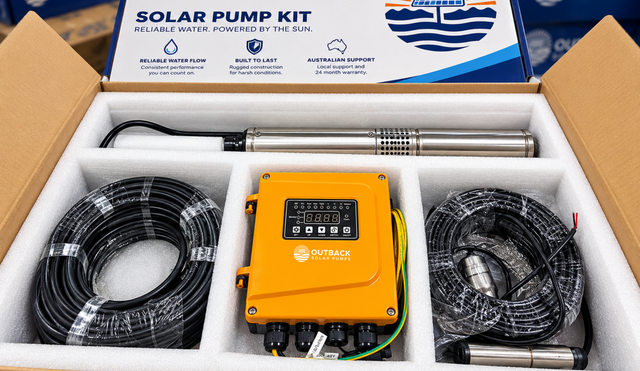
This is also why complete, matched kits matter. A good solar pump system is not just a pump with a panel bolted on. The controller, panel wattage, cable sizing, pipe friction, static head and daily water requirement all need to line up. Get that right and the system is predictable. Get it wrong and performance suffers.
AC pump vs solar pump for common property jobs
For bores supplying stock water, solar is often the better fit. Bores usually sit well away from mains power, and the water demand is ongoing rather than sudden. A solar bore pump filling storage through daylight hours is a clean solution.
For tank filling from dams or creeks, solar also makes strong sense, especially where transfer can happen gradually over the day. If the job is to keep a header tank up rather than fill a firefighting reserve in one burst, solar does the work efficiently.
For irrigation, it depends. Small-scale drip or low-volume transfer can suit solar very well. Large irrigation systems with high instantaneous demand may still favour AC, particularly where grid power is already available and pumping windows are fixed.
For homesteads or sheds with reliable mains nearby, AC may remain the simple answer. But if the site is off-grid or power extension is costly, solar can quickly become the smarter long-term buy.
What to ask before choosing
The best pump choice usually comes down to five practical questions. How much water do you need each day? How high and how far does it need to go? Is there dependable mains power at the site? Do you need full output on demand, or can you pump steadily into storage? And how much time do you want to spend maintaining engines, fuel, and backup plans?
If you can answer those clearly, the path gets easier. Properties that can pump through the day into tanks are prime candidates for solar. Sites that need very high-demand pumping at set times may lean AC. Some operations even use both - solar for everyday stock and transfer duties, AC for occasional high-volume tasks.
That sort of mixed setup is not overkill if it reflects how the property actually works. The mistake is forcing one pump type onto every job regardless of site conditions.
The better question is not which is best
The better question is which pump is best for this site, this water source, and this workload. That is why generic advice falls over. A shallow transfer from dam to tank is not the same as a deep bore on a remote grazing block. A house supply near the grid is not the same as livestock water ten kilometres from the nearest power line.
For many Australian rural applications, solar has a strong edge because it cuts fuel dependence, lowers running costs, and keeps water moving in places where generators become a nuisance. But AC still has a place where mains power is already there and the pumping duty suits it.
If you size the system properly and plan around real daily water demand, not wishful thinking, both can work. The job is to choose the option that gives you dependable water with the least fuss over the long haul. That is usually the decision you will still be happy with after the first hot summer puts the system to the test.