
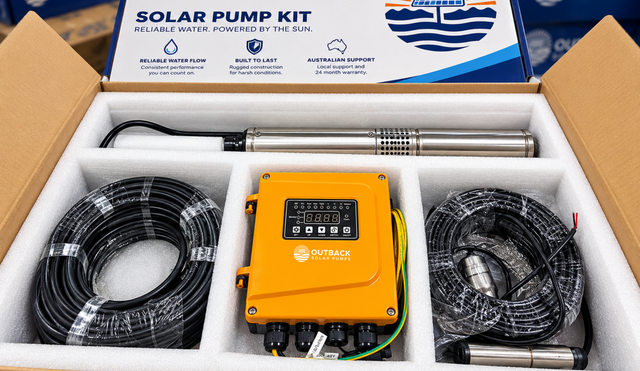


A bore can look straightforward on paper until the water level drops, the tank is on a rise and the troughs are a kilometre from the pump. If you are asking which pump suits deep bore water supply, the answer is usually a submersible solar bore pump sized around the actual pumping level, total lift and water required each day - not simply the bore depth.
For livestock, domestic supply, tank filling or small irrigation, a correctly matched solar bore pump can move dependable water every day without diesel runs, generator servicing or a power connection at the bore. Get the sizing wrong, though, and even a quality pump can deliver too little water, run outside its best operating range or struggle when conditions change.
Which pump suits a deep bore?
A submersible multistage bore pump is generally the right choice for a deep bore. It sits down the bore below the water level and pushes water up the rising main. This is far more effective than trying to pull water from depth with a surface pump.
Solar submersible pumps are particularly well suited to remote Australian properties because they run directly from solar panels through a matched controller. With no fuel to cart out and no mains power needed, they make sense for stock water, header tanks and off-grid water systems where daily reliability matters.
The key distinction is between a bore that is physically deep and one that has a deep pumping water level. A 100-metre bore may have water standing at 25 metres, while a 50-metre bore may draw down to 45 metres while pumping. The second bore can require the harder-working pump.
Start with total dynamic head, not bore depth
The most useful sizing figure is total dynamic head, often shortened to TDH. This is the total vertical and pressure load the pump must overcome while delivering water.
To calculate it, begin with the pumping water level. This is the depth from ground level to the water surface while the bore is running, not the static level measured after the bore has rested. Then add the height from ground level to the tank inlet or highest outlet point. Finally, allow for friction loss in pipework and any pressure needed at the delivery end.
For example, a bore with a 55-metre pumping water level, a tank inlet 10 metres above ground and an allowance of 10 metres for pipe friction has a total dynamic head of roughly 75 metres. A pump selected only because the bore is 80 metres deep may be oversized or undersized, depending on its performance curve and the flow you need.
Long poly runs deserve proper attention. A small delivery pipe may be cheaper initially, but it creates higher friction loss and can seriously reduce flow over hundreds of metres. Increasing pipe diameter often improves system performance and may allow a smaller pump or fewer solar panels. It is a practical trade-off worth checking before ordering equipment.
Static water level versus drawdown
Static water level tells you where water sits when the pump is off. Drawdown is how far that level falls once pumping starts. Add the two together and you have the pumping water level used for pump selection.
If no test data is available, arrange a bore flow test where possible. It is one of the best ways to avoid buying a system based on guesswork. The test should establish sustainable bore yield, static level, pumping level and water quality. A bore that produces 1,500 litres per hour for 20 minutes may not sustain that rate through a full sunny day.
Match pump flow to daily water demand
More litres per minute is not automatically better. The pump needs to match the bore yield and the water your property uses across the day.
A modest stock-water setup may only need a few thousand litres daily, while a large cattle operation, accommodation block or irrigation application may need substantially more. Solar pumping works best when water is pumped steadily into storage during daylight, then gravity-fed or pressure-pumped from the tank as required.
Work out the total daily requirement first. Include livestock numbers, household use, wash-down, evaporation allowance where relevant and a sensible buffer for hot weather. Then divide that volume by realistic solar pumping hours rather than assuming the panels will produce at full output all day.
As a rough illustration, if you need 12,000 litres a day and can expect six useful pumping hours, the system needs to average around 2,000 litres per hour at the required head. The pump curve must show it can achieve that duty point. A pump rating quoted at low head is not enough.
Avoid specifying a pump that outpaces the bore. If the pump draws water faster than the aquifer can replenish it, the bore can run down, the pump may cycle on low-water protection and daily output can fall away. A controller with dry-run protection is valuable, but correct matching is still the first line of defence.
Choose the pump type for the water and bore construction
Most deep bores call for a submersible helical rotor or centrifugal multistage pump. Both can be effective, but they perform differently.
Helical rotor pumps are commonly chosen for deeper bores and lower-flow applications. They produce strong pressure at higher heads and can be an excellent fit for stock troughs and tank filling where steady daily volume matters more than a high peak flow rate. Their rotors and stators are service items, so clean water and correct operation help extend service life.
Centrifugal multistage pumps generally suit applications needing higher flow at moderate to high head. They are often a good option when filling larger tanks or supplying greater daily demand, provided the pump curve matches the duty point.
Water quality matters as much as depth. Sand, silt or abrasive material can wear pump components quickly. If the bore is sandy, make sure the pump is installed at an appropriate depth above the bore bottom, with suitable bore protection and a system selected for the conditions. Iron, salinity and mineral content may also influence material choice and maintenance planning.
Do not overlook bore diameter and installation depth
A pump must physically fit the casing with enough clearance for cable, pipework and safe installation. Four-inch bores are common, but dimensions vary, especially in older bores. Confirm the internal casing diameter before selecting the pump.
The pump should be installed below the lowest expected pumping water level, while remaining clear of the bore bottom. Setting it too low can expose it to sediment. Setting it too high can leave it out of water during heavy demand or a dry spell. The right position depends on bore test results, screen location and seasonal water-level movement.
Use correctly rated bore cable, rising main and safety rope. These are not minor extras. A quality pump is only as reliable as the equipment holding it in place and carrying water to the surface.
Solar array and controller sizing are part of the pump decision
A deep-bore pump system is not just a pump with panels added afterwards. The pump, controller, solar array, cable length and delivery pipe need to be balanced as one working system.
More head and more daily water demand generally require more solar input. Panel orientation, local shading, seasonal sunlight and high-temperature performance all affect daily output. In remote locations, a well-sized array and a controller designed to protect the pump from low voltage and dry running are worth more than a headline pump rating.
For most stock-water jobs, storage is cheaper and simpler than battery storage. Pump into a tank while the sun is available, then let the tank provide reserve capacity overnight and through cloudy periods. A float switch can stop pumping when the tank is full, reducing overflow and unnecessary run time.
Information to have before choosing a deep bore pump
A supplier can size a system accurately when you can provide the bore depth, casing diameter, static water level, pumping water level, bore yield, delivery height, pipe size and pipe length. Add the daily litres required, tank capacity, water quality and intended use.
If some figures are unknown, do not fill the gaps with optimistic estimates. Measure what you can and flag what is uncertain. Outback Solar Pumps can help turn those site details into a balanced solar pumping package, including the pump, controller, panels, cabling and mounting gear needed for the job.
When a different setup may suit better
A deep submersible bore pump is not always the answer. A shallow water source may be better served by a surface transfer pump. A dam, creek or open well can need a different intake arrangement. If the bore produces very little water, a low-flow pump operating over longer daylight hours may be the better result than a high-flow model that repeatedly runs the bore dry.
For high-pressure irrigation, consider whether the solar bore pump is filling a storage tank or directly supplying irrigation. Direct pumping can work in the right conditions, but storage gives more control over flow and timing. It also means the bore pump can run when solar production is strongest instead of being tied to the irrigation schedule.
The best deep-bore system is the one that quietly puts the required water in the tank day after day. Start with honest site measurements, allow for summer demand and pipe friction, and size the pump around the water level you pump from - not just the depth written on the bore log.